- Home
- Book 1 - No Not One
- Book 2 - No Not One More
- APPENDIX A - THE 7 FEASTS
- APPENDIX B: Ezra Who
- APPENDIX C: Bethlehem?
- APPENDIX D: Order-Meaning
- Disclaimer & Back Story
- Reflections #1-2-3
- Reflections #4-5-6
- Reflections #7-8-9-10
- Reflections #11-12-13-14
- Reflection & Prayer
- Footnotes/Scripture Index
- Benediction & Back Cover
Chapters 13 & 14
Chapter 13
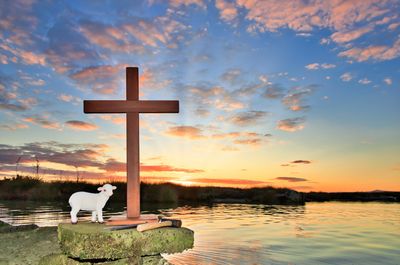
LAMB OF GOD
“Behold, the Lamb of God”
The New Testament introduces Jesus with a title that carries unmistakable sacrificial meaning:
“Behold! The Lamb of God who takes away the sin of the world!”
— John 1:29¹
This declaration, spoken by John the Baptist, does not emerge in isolation. It draws directly from Israel’s sacrificial system, particularly the Passover lamb described in the Torah. John’s words frame Jesus’ identity from the outset—not merely as teacher, prophet, or miracle worker, but as sacrifice.
The Passover Lamb in the Law
The instructions for the Passover lamb are precise:
“Your lamb shall be without blemish, a male of the first year.”
— Exodus 12:5²
These requirements are not incidental. A lamb “of the first year” refers to an animal in the fullness of its youthful strength—neither immature nor weakened by age. It represents vitality, purity, and wholeness.
In the land of Israel, lambs are born in the spring, during the season known as chodesh ha-aviv—“the month of Spring.” This agricultural reality establishes the natural context for the Passover sacrifice.
If the Passover lamb was to be one year old at the time of sacrifice, it necessarily would have been born in Spring, around the month of Nisan.
Jesus as “Our Passover”
The New Testament explicitly connects Jesus to the Passover sacrifice:
“For indeed Christ, our Passover, was sacrificed for us.”
— 1 Corinthians 5:7³
This statement does more than assign symbolic meaning. It identifies Jesus as the fulfillment of the Passover lamb—one whose life, death, and timing align with the redemptive pattern established in Exodus.
Within this framework, a Spring birth for the Messiah is not asserted as fact, but recognized as theologically coherent. The Lamb enters the world in the season when lambs are born. Redemption begins where sacrifice begins.
Shepherds, Watchfulness, and Preparation
Luke records that shepherds were tending their flocks outdoors at night at the time of Jesus’ birth (Luke 2:8).⁴ This detail aligns naturally with the Spring lambing season, when shepherds would remain especially attentive to protect newborn lambs from injury or defect.
While Scripture does not state that these shepherds were responsible for Temple sacrifices, the imagery is unmistakable. Shepherds familiar with lambing, inspection, and protection are chosen as the first witnesses to the birth of the One later identified as the perfect sacrifice.
The angel’s sign to them was specific:
“You will find a baby wrapped in swaddling cloths and lying in a manger.”
— Luke 2:12⁵
Newborn lambs were often wrapped to prevent injury and preserve their suitability for sacrifice. The parallel is not presented as historical certainty, but as symbolic resonance—imagery that would have been immediately intelligible to those whose lives revolved around lambs.
Symbolism That Serves, Not Replaces, Scripture
The connection between Jesus as the Lamb of God, the presence of shepherds, and the season of Spring is symbolic, not doctrinal. Scripture does not require this interpretation, but it allows it.
These converging elements:
- do not redefine the Gospel
- do not demand a precise date
- do not rest on later tradition alone
Instead, they reflect a consistent biblical pattern: God introduces redemption using language His people already understand.
The Lamb of God enters the world quietly, watched over by shepherds, wrapped with care, and placed in humility—foreshadowing a sacrifice that would one day be offered publicly, deliberately, and completely.
Conclusion
Whether or not one accepts a Spring birth as historical certainty, the theological message remains unchanged.
Jesus is the Lamb.
Jesus is the Passover.
Jesus is the sacrifice God Himself provides.
From birth to death, His life unfolds within the framework of redemption established long before His arrival.
The Lamb entered the world not by accident, not in spectacle, and not out of season.
He came in the fullness of time.
References — Chapter 13 (NKJV unless noted)
1. John 1:29
2. Exodus 12:5
3. 1 Corinthians 5:7
4. Luke 2:8
5. Luke 2:12
Chapter 14
PASSOVER SYMBOLISM
Passover and the Language of Redemption
Passover stands at the center of Israel’s redemptive story. Its themes—an innocent lamb, sacrificial blood, deliverance from bondage, and protection from judgment—form the foundation of biblical salvation theology.
These same themes reappear unmistakably in the New Testament, where Jesus is identified as both the Lamb of God and “our Passover.”¹
Because Passover always occurs in the month of Nisan, the association between Jesus and Passover naturally invites reflection on the timing of His life—not only His death, but His arrival.
The Original Passover: A Pattern Established
The origins of Passover are recorded in Exodus 12, on the eve of Israel’s deliverance from Egypt. God instructed the Israelites to:
- Select a lamb without blemish
- Slaughter the lamb
- Apply its blood to the doorposts and lintel
- Eat the lamb with unleavened bread and bitter herbs
- Remain ready to depart from slavery
When the destroying angel passed through Egypt, the presence of blood marked the homes that belonged to God’s covenant people. Judgment “passed over” those covered by the blood, and Israel was set free.²
This act of obedience secured deliverance—not through merit or power, but through substitution.
Jesus as the Fulfillment of Passover
The New Testament explicitly identifies Jesus as the fulfillment of this event:
“For indeed Christ, our Passover, was sacrificed for us.”
— 1 Corinthians 5:7³
This connection is not incidental. The parallels are precise:
- The Perfect Sacrifice
The Passover lamb had to be spotless. Jesus is presented as sinless—the only sacrifice sufficient to bear the sins of the world.⁴ - Substitutionary Atonement
Just as the lamb died in place of the firstborn, Jesus died in place of sinners. His blood secures deliverance from judgment through faith. - Freedom from Bondage
Passover freed Israel from physical slavery to Pharaoh. Christ’s sacrifice frees believers from spiritual bondage to sin and death.⁵ - Timing
Jesus’ crucifixion occurred during Passover, coinciding with the sacrifice of the lambs in Jerusalem—underscoring fulfillment, not coincidence. - The New Covenant
At the Last Supper, a Passover meal, Jesus redefined the bread and wine as symbols of His body and blood, establishing a new covenant grounded in His sacrifice.⁶
Through these fulfillments, Passover moves from ritual remembrance to completed redemption.
From Birth to Sacrifice: A Coherent Pattern
The New Testament does not state the date of Jesus’ birth. However, the symbolic alignment between Jesus and Passover provides a coherent theological framework.
If Jesus is the true Passover Lamb:
- and Passover occurs in Nisan
- and the Passover lamb was required to be one year old
- and lambs are born in Spring
then a Spring (Nisan) birth for the Messiah fits naturally within the redemptive pattern established in Scripture.
This conclusion is symbolic, not dogmatic. It does not assert certainty where Scripture is silent, but it recognizes consistency where Scripture is intentional.
The Feasts as God’s Redemptive Blueprint
Many Christian scholars have observed that the biblical feasts (moadim—appointed times) function as a prophetic outline of God’s plan of redemption.
Feasts Fulfilled at the First Coming
The four Spring feasts are widely understood to have been fulfilled literally and in sequence during Jesus’ first coming:
- Passover
Jesus was crucified as the Lamb of God, delivering believers from judgment. - Unleavened Bread
Jesus, sinless and uncorrupted, lay in the grave as leaven—often a symbol of sin—was removed. - Firstfruits
Jesus rose from the dead on the Feast of Firstfruits, becoming the first to rise in resurrection life and guaranteeing the future resurrection of believers.⁷ - Feast of Weeks (Pentecost)
Fifty days later, the Holy Spirit was poured out, inaugurating the Church and beginning the great harvest of souls.⁸
These fulfillments occurred not only in meaning, but in timing.
Feasts Anticipated at the Second Coming
The remaining Fall feasts are commonly understood as prophetic and await fulfillment:
- Feast of Trumpets (Rosh Hashanah)
Anticipated as a future call, awakening, and gathering associated with Christ’s return. - Day of Atonement (Yom Kippur)
Associated with judgment, repentance, and national restoration, particularly concerning Israel. - Feast of Tabernacles (Sukkot)
Symbolizing God’s eternal dwelling with humanity, fulfilled when Christ establishes His kingdom and “tabernacles” among His people forever.
Between the Spring and Fall feasts lies a deliberate interval—the present age—reflecting God’s patience and mercy.
Conclusion
Passover is not merely a historical event. It is a template.
Jesus fulfills Passover not only through His death, but through the entirety of His redemptive mission. His life aligns with God’s appointed times—from arrival to sacrifice to resurrection.
Nisan is the month of redemption.
Passover is the shadow.
Christ is the substance.
Seen through this lens, the story of Jesus unfolds not randomly, but deliberately—according to a pattern established long before Bethlehem.
References — Chapter 14 (NKJV unless noted)
1. John 1:29
2. Exodus 12
3. 1 Corinthians 5:7
4. John 1:29; Hebrews 4:15
5. Romans 8:2
6. Luke 22:14–20; 1 Corinthians 11:23–25
7. 1 Corinthians 15:20–23
8. Acts 2